The framing contractor who assembled several Ace-designed houses in northern California sought a new house for his extended family and himself, in a residential development adjacent to a golf course, alongside a rain forest in the mountains above Tegucigalpa.
The environs of Honduras' capital city must surely be at the frontier of this form of development, which began in the United States, and has since spread globally. Houses adjacent to the site are turned out "Spanish", with red clay tile roofs, white stucco walls, and dark woodwork.
This aggressively bland style, so characteristic of suburban sprawl, nonetheless has among its roots vivid and memorable places, including Los Angeles in the 1920s, Mexico in the 18th century, and Spain in the centuries preceding. Over time, style may be thought to travel.
Another appealing, if minor, expression of 1920's Los Angeleno interest in exotic places, was the Mayan Revival, which saw stores, gas stations, and especially houses made up as small-scale temples and observatories, often set in lush, though tiny jungles.
With the proximity of Copan, and other archaeological sites, to the lot by the golf course, we thought it time to revive the Mayan Revival, to bring home a wayward style that had earlier wandered to L. A.
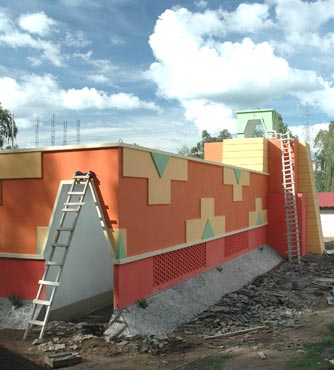
Entrance to the Saravia Residence is through a street-fronting gate, set on axis with an open, skylit corridor, leading to the public rooms, and beyond to the court. The house appears set on a stone plinth, above which a plain, horizontal band is topped by a geometrically patterned wall. Rooms and circulation open to a large court, at the house's center, from which are stairs to the roof. A stepped tower at the court's corner houses the owners' rooms; and provides a high platform with views to the dense forest in the distance, and aspiring Tiger Woodses closer by.
While construction for the exterior of this Classically Mayan-styled villa nears completion, work on the Ace-designed interior is now also underway. Elements include Mayan Revival architectural pieces, furnishings, fabrics, light fixtures, and pottery decoration. Completion is scheduled for 2009.
The environs of Honduras' capital city must surely be at the frontier of this form of development, which began in the United States, and has since spread globally. Houses adjacent to the site are turned out "Spanish", with red clay tile roofs, white stucco walls, and dark woodwork.
This aggressively bland style, so characteristic of suburban sprawl, nonetheless has among its roots vivid and memorable places, including Los Angeles in the 1920s, Mexico in the 18th century, and Spain in the centuries preceding. Over time, style may be thought to travel.
Another appealing, if minor, expression of 1920's Los Angeleno interest in exotic places, was the Mayan Revival, which saw stores, gas stations, and especially houses made up as small-scale temples and observatories, often set in lush, though tiny jungles.
With the proximity of Copan, and other archaeological sites, to the lot by the golf course, we thought it time to revive the Mayan Revival, to bring home a wayward style that had earlier wandered to L. A.
Entrance to the Saravia Residence is through a street-fronting gate, set on axis with an open, skylit corridor, leading to the public rooms, and beyond to the court. The house appears set on a stone plinth, above which a plain, horizontal band is topped by a geometrically patterned wall. Rooms and circulation open to a large court, at the house's center, from which are stairs to the roof. A stepped tower at the court's corner houses the owners' rooms; and provides a high platform with views to the dense forest in the distance, and aspiring Tiger Woodses closer by.
While construction for the exterior of this Classically Mayan-styled villa nears completion, work on the Ace-designed interior is now also underway. Elements include Mayan Revival architectural pieces, furnishings, fabrics, light fixtures, and pottery decoration. Completion is scheduled for 2009.